
Now That You’ve Caught the Car…
A year ago, when I finally decided that I did want to do the Jefferson Science Fellowship program, I said I wanted an adventure experience, unlike anything I would likely have back on campus. I said that I wanted a front-row seat for the challenge and complexity of governmental transition. I wanted to learn about the language of statecraft. Well, I hadn’t imagined that it would be like this. But of course, that is the nature of great adventures.
I came into work today, the day after Thanksgiving, not because I was too work obsessed to stay home, but because we need some coverage at the desk. For most of the world, this is just another work day. Who knows what might be happening? There are news stories about various Asian governments—how do they affect my science and technology portfolio? Has the President-elect selected a nominee for Secretary? Are there any more earthquake aftershocks affecting eastern Japan? Yes, this is exactly what it is to be embedded in a regional bureau of a high-profile international diplomatic alliance. And whether or not I knew it, that is what I was asking to learn.
The image I’ve had this week is that of a dog, just at the moment of catching the car it has been chasing, suddenly recognizing its success and now forced to ask a fundamental (even existential) question: Now what do I do? With a little extra time today, I was able to find some versions of exactly that image. I would like to say that it’s just coincidence that the contexts of the images are cars and politics, but I can’t really promise that. I do know that one of the nicer (apolitical) images does come from a blog that extols the pleasures of driving Porsches with manual transmissions.

http://pedrosboard.com/read.php?7,40968,40994
I cannot disagree with that philosophy, of course; it’s just that my time driving is limited these days to a few weekend visits back to Indiana. After years of dreaming and theorizing about it, I really do have the experience of “getting up at home, going to the very familiar home airport, flying a couple of hours, landing at the very familiar home airport, and going home”. I joked with a friend about “checking on the country manor on my days away from my suite of rooms at the capital, attending to affairs of State”. Perhaps amusing, perhaps pretentious… but very apt (except that the house in Lafayette is not quite the country… but it feels like it compared to downtown DC).
There is even a broader political version of this question that grips Washington. I don’t really want to spend my time engaged in national politics, but I do like the cartoon.
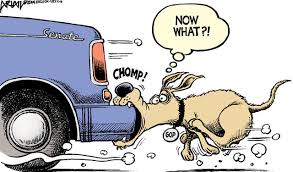
https://thewiddershins2.wordpress.com/2015/06/19/dog-catches-car/
Although I did say I wouldn’t do politics, I do want to describe something very wonderful and remarkable that has sustained me over the past fortnight. Every day, as I come to work, I get on the (public transit) bus with a number of other government workers. The security guards are just as friendly and engaging as they check my badge. I walk to my office, and there are still all of the elements of bureaucracy and statecraft on Nov 25 as there were on Oct 25. Some of the questions I field, and media reports I read, are very different because of ecstatic elephants rather than dancing donkeys in the neighborhood. But some of my colleagues remind me that this level of continuity would not have been the case in other places where they have worked.
Admittedly, there are protests and disillusionment and frustration; I think this would have been true even with the dancing donkeys outcome. I have managed to miss the protests that are active a few blocks from my apartment—not because I’m uncaring, but because I need to have something constructive to do in the face of confusion and disorder. My something to do is very concrete and actionable: support the science, technology and innovation elements of the U.S. – Japan alliance. Living in Washington as an engineer focusing on the social context of technology development and innovation does give me a dual view of the world. Understanding how technology works does change one’s view of how context matters, and how the stories that are told influence whether some innovation is considered a source of wonder or woe. I am also challenged by what seem to be violations of my empirical approach: I have a theory about the way I want the world to work. I have a set of data that conflict with that theory. I will now try to force the data to fit my pre-existing theory, rather than try to come to a broader understanding of the world (and develop an improved theory) based on the data I have observed.
Maybe I would have enjoyed history and social science classes in high school and college more if I could have learned more about triangulation and context description and system dynamics. But I don’t regret having this perspective, or even the sense of disorientation I feel when reading the news reports. There is some very pretty math emerging about developing the right configuration of dynamic applications of inertial policy to enable critically damped responses to geopolitical challenges using an optimal steering strategy (which Norbert and Jay might have called Cybernetic Statecraft). I have a close-up view of ways it’s working, and ways it is very poorly implemented (both now, and in the past). More importantly, I need to be able to explain this to people who *are* historians and policy studies and language majors.
Well, that’s a pretty clear view of what I need to do next, and why it’s good for me to be here, right now, doing it. Woof.
 grouperlab
December 10, 2016
Icons and Orbits
Yesterday became a reminder of the special experience that this year has become. I didn’t really plan on it, but as they say, I was in the neighborhood. In the nature of adventures, that’s what made the exploration even more memorable and valuable.
On Friday morning, I had the opportunity to watch the launch of the Japanese H-II HTV-6 cargo transfer vehicle to the International Space Station from JAXA’s Washington DC Headquarters. Of course, this was a special privilege to be able to share the excitement with the U.S. office of JAXA; I was also honored that the staff was able to find a place for me to attend. I’m not sure they initially understood my enthusiasm for the launch as a rocket scientist, and not just a representative of the State Department, but after some discussions of orbital approach velocities and the functions of the GC, PAO, and PHALCON consoles in the ISS, I think my excitement was clearly interpreted as longstanding and real. Having completed that activity, and then walking over to my office at the State Dept., it was time for some research.
I’m supposed to finish a book chapter on aerospace human factors, and most of my references are back in Indiana. So, the thinking went, where’s the next best place? Although NASA Headquarters is also nearby, it was easy to pick up the bus to take me to the National Air & Space Museum (NASM), where I knew I could take some pictures and take some notes from one of the books in the museum shop. Upon entering the main hall, though, I was frozen in place. Even now, trying to write up this entry, my emotions threaten to get the best of me. The voices whispered to me from the ages and the vehicles:
Godspeed, John Glenn.
The children playing at the interactive wall couldn’t hear the voices. Maybe not yet.
Figure 1: Children at the Air and Space Museum interactive video wall
Of course, I couldn’t hear the voices either, the first time the words were spoken into the radio and broadcast. (I existed on February 20, 1962, but just barely. I wasn’t born until that September.) I remember learning them later, as part of the lesson of where bravery and commitment and ingenuity and perseverance could take us. One of the images on the wall was an iconic photo of Glenn with his Mercury capsule, where he would hear the voice and become the first American to orbit the earth. The New York Times had that iconic photo on its front page yesterday:
Figure 2: John Glenn with Friendship 7, from New York Times story
https://static01.nyt.com/images/2016/12/08/us/glenn-obit-1/glenn-obit-1-blog427.jpg
But the power of the moment came a few minutes later, as I realized: it’s here. Friendship 7, just a few paces away. Surprisingly, there were only a few people there, providing me more than enough time to feel the prick of tears, appreciate the bouquet of memorial flowers, and recognize the sacred touch to my core.
Figure 3: Friendship 7 at NASM, with bouquets.
For years, I had thought that I was supposed to be like John Glenn. I wanted to be an astronaut, no? And there he was, not a fictional creation, but a real person. That’s achievable, right? That’s the model of what an astronaut can and should be? Well, not quite. Even the other Mercury astronauts didn’t live up to the image of John Glenn, a story of love and good behavior as an icon that only pushes down further on the scales of history. That’s not what or who I am, though I deeply honor someone who could be so completely that person: even meeting him years later, well after being Senator Glenn and the crew member responsible for the Space Shuttle moniker “Discovery 7”, I had a sense that he was just being himself. And yet there is a lesson in there for me, even if I cannot be that person.
In lab meeting this past week, GROUPERs and I discussed the future of the lab, and what would best achieve the goals I have for myself and the remainder of my career. In essence, my query and fear was over a lack of effect or impact. And yet, I can recognize that my best work is done when I am most devoted to doing what I am built to do, what lives at the depths of my core. There is a lot I “can” do, in the sense that I have a range of skills and aptitudes. But just because I can do it, that doesn’t mean that is what I must do. For some tasks, not only are there others better suited for it, but I am not ideally suited to do it; it would take away from what I am best designed to do. I wasn’t really ready for what I heard next (but I want to let you know that I am learning to hear these voices, too).
GROUPER doesn’t recruit in a standard way. It’s not about ranking applicants on the basis of grade point and GRE scores. It’s about detecting “signs of life,” as I describe it. But, from the other side, that of the students who thrive best, there seems to be something else. It’s about someone who listens, and cares, and is passionately able and willing to alter the trajectory of one’s life. That is something I love to do, burn to do. It’s not the most lucrative choice, or the one with the most fame or adoration associated. How many people have I affected in this way? All of my estimates are too low. I undercount my effect in the lab now. I undercount it among the lab alumni (but maybe I should start coming to visit you, just for a day or two, and have another conversation with you and those who you think might be good for me to talk to), and among the students in class who go about their lives in some different way because of something they saw, or heard, or felt. In more mature consideration, I realize that the real reward is to be doing what I need to be doing for its own sake, not because of the external acknowledgements or rewards.
Doing what one was built to do, out of a sense of duty to a broader purpose… a passionate life. Defining one’s work, and one’s job, differently than just being based on an income, but by being able to touch others and having left the world better. That’s perhaps not a common framing of holding, or doing, one’s job… but common or not, this sense of purpose was part of Glenn’s holding a job. Doing what Glenn did, because he did it, isn’t the point. Doing what I do, because it is what I should be doing, is.
All the flags are at half staff today. But I don’t feel like I’ve lost someone. I feel like I’ve gained. I welcome the reminders, the tears and the passion, and most of all, the voices.
Godspeed, John Glenn.
Share this: