grouperlab

Get, share, and use information well

Category: Commentary

Returning to Practice

I’ve been interviewing Millennials for work.


In one sense, that is no surprise at all.  Many of the students applying for graduate programs stay in the same age range.  I have, by contrast, gotten older.  Incoming students who were approximately my age (or older) are now the age of my children (or younger).  This is the nature of the cycle of life (cue the music from “The Lion King,” which is now considered “Classic Disney”).  So, why was this experience different?


First, and most important, was that I was not interviewing people for work in the Lab.  These were postdoctoral fellows applicants for Department of State positions.  The vast majority of them are still just a few years from their PhD dissertation, experiencing a very different world and context than I did when I was interviewing for my first faculty position.  Well, that suggests another difference: I interviewed for a faculty position, and never seriously considered a postdoc.  I have spent months engaged with discussions of the role of scientists and engineers engaged in Science Diplomacy, and the interplay of innovation and policy—quite frankly, the education I had come to Washington to have in this very interesting and challenging period.  These folks aren’t being recruited to work on my favorite projects, or to have exactly the sort of background I would like a GROUPER to have… but there was still a request from my unit chief for what sorts of people to identify in the stack of resumes and personal statements.


Signs of life.


I was starting to wonder about what that would look like in this context, and in fact, I was starting to question if my time away from the university had left me cynical or unable to see beyond my own narrow daily priorities.  Maybe it was a broader sense of unease with the sudden transition from a snowstorm in late March to 90 degree days in late April.  Where and how and when was I operating?  (I had come to feel a certain sense of stress and negative anticipation regarding my transition back to Purdue, starting in late March when I was requested to provide new course syllabi for my Fall classes.  There are new opportunities for next academic year, but after eight months here in Washington, I am neither ready to start right back in on the academic world, nor think in terms of another full annual cycle of activity here.)


And yet, my unit chief wanted me to not only be involved in the interviews, but to craft a few questions for them.  It was, as I have said before, a bit different to operate in support of others, instead of being my own “Principal,” but that is part of my learning these days.  I’ve also been learning a lot about the differences in cultures of science, and hearing about the distinct experiences of what I have come to call, “Millennial Scholars” (those who may be part of the generation born in 1985 or later, but also have completed their advanced STEM degree programs since 2010).  I’ve even produced a few of those people myself, but I already knew enough not to look for people just like Ashley or Karim or Marissa or Jeff (or those who are in the lab now).  The discussions in the AAAS meetings in Boston and Washington still had an immediacy and curiosity to me: I was meeting so many people interested in a concept, science policy, that I had long thought was an oxymoron.  Why were they interested in this?  What new was going on?


What are the challenges and opportunities, strengths and weaknesses, of these Millennial Scholars?


This is, in my experience with the lab, a “signs of life” question.  Signs of life it had become a part of my thinking at a time where spring is definitely upon us in Washington.  I’m walking much more around the city again, and over the past few weeks, I have been able to enjoy the cherry blossoms and new plants and warm weather.  In other words, “signs of life returning” was part of my daily experience.

IMG_4993

Figure 1. Signs of life: Tulips at the bus stop


The answers were also informative, as well as reminders of an earlier age.  There were those who seemed to have trouble thinking about themselves, and their colleagues, in such a comparative context.  However, this compared to several who actually commented about the relative lack of a sense of historical comparison as a weakness of Millennials.  What was another weakness?  There were several comments about the ease with which new information and new activities and experiences were available, leading to a sense of being dabblers in a variety of skills (“jacks / jills of all trades, masters of none”).  In fact, that ease of collecting and novelty even extended to the strengths and weaknesses of networking.  Although the world of embassies and interagency discussions and think tank receptions clearly indicates a value to the work of engaging with others… there is a difference between engaging in an effective, distributed knowledge network, and collecting friends and likes as a way of keeping score.


I found myself curiously replaying one conversation in my mind, about the concept that Millennials were more interested in finding ways to align their actions and employment with their passions.  Now remember, I lived in Cambridge, MA and California during the 1980s startup crazes, where people were all about passion.  I heard the Flower Children talking about living a life of meaning and service.  And, most importantly, I have learned how much my career as a professor is actually well aligned with my passion for exploration and sharing what I found.

IMG_5018

Figure 2. Albert sharing a sense of passion.  Maybe science diplomacy was never so far from my thinking after all.  (At the National Academies Keck Center, 500 E St NW)


Was this really different?  And then I heard an interesting alternative take on this thought.  “Well, if I can’t rely on a pension or Social Security to be around, there is no reason for me to trade boredom for security.”  From that discussion, I was transported back to the first few times I taught the course Sociotechnical Systems at Wisconsin. I had known about two different models of work and income as “covenants”:  income and status as a way of demonstrating success and favor, or work as a demonstration of one’s passion and artisan’s skills.  It took discussion and debate in class for me to learn that there was a large population with a third approach: work was something one does to get enough income to spend the rest of one’s time doing what one really preferred to do.  Apparently, lots of people live that way, whether they’re working second shift at the auto parts store, or vice president of global distribution for the auto parts company.  I have not chosen to live that way, and I can’t really imagine doing something I hate just to have the income to do what I love, later.  Is that what others were assuming we were all doing?  Or were others doing this a lot more than I was ever aware?


I felt like I had come full circle in the discussion, and my awareness of my own experience as a young scholar.  I am convinced that there are confusions in each generation, not sensing the range or intensity of experience from when prior generations were young and emerging, like new plants bursting into the sunlight and struggling against snow and wind and dangerous frost.  I can appreciate it much more now, because I have been in both places, and I have come to feel them both.  I am not yet done with the intensity of feeling and learning.  And yes, I am still pleased to take a moment on a Spring day and feel the sensual joy of lamb’s ear as I walk from meeting to office or home.  Because, even after a great enlightenment, a return to practice and repeat of small things still has value.

IMG_5065

Figure 3. Lamb’s ear on 19th St NW.  A good reminder of small lessons.


Weekend Balance #2: Cassandra’s Postcards

Curiously, the concert that I left work to attend last night was something I discovered almost exactly one week earlier (even to the same clock time).  The group I went to see was Black Violin, two classically trained violinists who are a) black, from Ft. Lauderdale; b) insistent on thinking outside of the box; and c) have a strong alternative vision of how the world can be different than it is, beyond existing stereotypes or interpretations.   (Yes, the highlighted words and links are in fact the names of their albums.  Go listen.)  Last Friday, I was on the train to spend the New Year’s holiday in my hometown of Philadelphia with friends.  I had put on the music just for some simple enjoyment, and found myself transformed and emotionally intense and resonant.  (Yes, it’s also when I found out about their concern in Washington, DC last night.)

img_4758

Black Violin, with the National Symphony Orchestra, Feb 6, 2017

One of my favorite descriptions of my approach to the world was provided by a GROUPER a couple of years ago, during a 1:1 meeting at a conference.  (I can still see the design of the French patisserie / café in my memory.)  The description was that I live part of my existence in the future, but the nice part is that I “send postcards”.  This is a delightful image, but it hides a painful and problematic truth: not everyone can receive “postcards from the future,” or even know that they exist.  I used to think this was a simple problem of better explanation, but I have had to come to the recognition that there is more at play.  An alternative metaphor comes from my son, who once made a surprised and surprising revelation once when watching me dance to a piece of music to which I resonated very strongly.  He admitted that he had thought that I simply didn’t have a very good sense of rhythm.  Then, as he got older and started thinking more seriously about music composition and production as a career, he listened to more music, more often, at a deeper level.  His statement at a friend’s house was with a type of confused awe: “You’re trying to dance to all of the notes, not just the normal beat.”


One of my favorite and most inspirational books of my life is called Cyteen, for a number of reasons (including some too complex to go into here).  I am particularly taken by one of the descriptions of a major protagonist’s sense of their life’s work… that, if they are devoted and dedicated to their passion and their gifts and their uniqueness, because of and not simply despite their unique or alternative make-up, they may have the opportunity to someday speak their “Word,” their major contribution to history’s arc.  While Speaking Words to History sounds pretty cool (at least for my sense of doing what I was built to do), it comes at a major, even profound cost.  I am drawn most to the myth of Cassandra, who was cursed for defying the god Apollo (isn’t that usually how things like that turn out?) by being able to see and foretell the future, but being unable to alter it, and being doomed to have others not believe her when she told them.  (I have to hand it to Apollo, though: that’s a pretty exquisite form of sadistic torture.  But really, just because she turned you down for a date?  I mean, you’re a god and all…)

800px-cassandra1

Poor Cassandra.  (From Wikipedia page, public domain image: Cassandra (metaphor)

It’s really hard to explain to GROUPERs the process of finding and sending postcards from the future, and more importantly, I don’t think it’s a proper thing for me to insist that they do so. For nearly all of the students I’ve met, it’s not the right lesson to be teaching, and there are certainly a wide range of valid and important jobs that one can take on without invoking divine curses.  Having someone who can simply receive the postcard, and translate part of it, is worth a lot.   For example, our current experiences of politics, local and national security, and even the nature of honest communication is based on elements of situational context, information cues, and media characteristics of different information and communication technology channels.  We’re asking about tolerance and acceptance of new communications media in various organizations. That sounds like a really great research project, especially when combining new forms of social messaging as various types of an advanced, or evolved, model of email (written electronic communication), or other group interactions (with or without audio and video capabilities).  It might still be considered a bit ahead of the curve, or timely, because we’re in the midst of it now.  But consider a study of organizational acceptance of alternative media channels conducted in 1992, fully 25 years ago.  That’s before there were any iPhones, or web browsers, or T1 lines (or many of my students).  No graphical email or tweets with emojis.  Do the questions even make sense?  For most people, not really.  (At least that’s the memory of reviewer comments for the Taha and Caldwell, 1992 submission to the Human Factors Society conference.)

Back to the train last Friday.  Imagine me trying to dance to all of the notes as the train pulls into (and then out of) Philadelphia as I continue my journey.  The lights of Philadelphia’s Boathouse row are still holiday festive.  I am crying my resonance to the music playing in my ears.  I finally feel like a type of homecoming has occurred, one that I had sought in vain for nearly 40 years.  In the midst of this, an insight.  Normally, I wouldn’t tell anyone, or I’d write it up piecewise in journal papers.  Not this time.  I’m going to show you the postcard here.


View #1:  The Spectrogram

A few years ago, Jeremi London (not the actor) and I worked on a model of STEM education based on the concept that what we in fact try to teach engineers in order to be functional, productive engineers is not a single thing, but a large matrix of skills, habits, attributes, and techniques.  Different courses supposedly load on different matrix elements, and different students have different strengths and weaknesses in those elements.  I visualize this as a type of dynamic matrix of peaks and valleys, as you might get in a audio spectrogram.   What we might think of as intelligence or skill or functionality is actually an aggregation of those peaks and valleys across that range of matrix elements: a person’s functionality is, generally, how well their peaks map onto the things they need to do on a daily basis.  Zero functioning is actually hard to imagine, and if most of the population was in fact functioning at zero, we might not even see it as a relevant matrix attribute element to consider.  (If someone had a peak there, would we even think about it as a peak?  Consider the question of tetrachromats.)  For the sake of analysis and comparison, it’s important to both retain the spectrogram as a matrix, and also consider a simplified representation of it.  You could call it IQ or something.  Let’s just describe it as the determinant of the functionality matrix.


View #2: The Bowl

Some of you know that I have a deep, longstanding, and personal interest in questions of neurodiversity: creating models of acceptance, encouragement, and tolerance for people with different sets of skills and forms of excellence.  (This isn’t just a “feel good” about diversity and tolerance as a moral issue.  This is about benefitting from excellence where it is found, including functionality peaks due to alternative wiring that represent “signs of life” not common in the general population.  Well, if you’re training PhD students, that’s not a bad thing to look for: higher, and more distinct, functionality peaks than exist in the general population.  After all, not that many folks get PhDs.)

So, the more your spectrogram pattern of peaks and valleys differs from the standard version (not just higher peaks, but peaks in different places), the less “standard” you are.  (Standard, in this case, represents not just the population norm of the matrix determinants, but the modal matrix pattern.)  In an extreme case, someone with a whole lot of peaks in places where standard people are close to zero, and very low functioning where standard people have peaks, would find it exceptionally hard or impossible to communicate with standard folks at all.  (The concept of “communication” here might work as a multi-dimensional convolution integral, or a multiplication of functions against each other.  You don’t worry about that just now, unless you really want to.)  The more non-standard a person is, the further their pattern is from the standard pattern, and the more overall capability and functionality it might take to compensate for the mismatch, and be seen as equivalently functional as the modal, standard person.  If we considered a function where the matrix determinant was the height, and the difference in pattern was a radius (different types of different patterns would be angles, so we’re in polar coordinates), the “bowl” would be a surface of “equivalent perceived functionality,” with an edge being at a place where someone, no matter how many peaks they had or how profoundly high those peaks are, could not interact with standard folks well enough to be seen as functional.   (So, you can’t see in our standard visual spectrum?  Well, we think you’re blind, even if you have a great visual experience of radio waves.  Too bad if you can hear and sing the vibrations of the planet.  We work in 200 – 4000 Hz, thank you, and if you can’t hear or produce in that range, we won’t hear what each other is saying.  Literally.)


View #3: The Disk

Another of the elements we have been playing with in the lab gets the shorthand description of “The Six Dimensions of expertise,” with a corollary of “the disk”.  As we described the matrix above, there are lots of different ways we could organize the elements of the matrix of ways people are good at different things.  They may be socially skilled and charismatic; they may be great with tools and interfaces; they may enjoy structured rules and processes; they may enjoy mathematical analysis and quantitative exploration.  There are other ways to slice skills up into different collections, but there’s been a lot of work recently into “four-quadrant” cognitive styles inventories that are used in organizational assessment.  For the purposes of this discussion, all this tells us is where in the spectrogram the matrix elements of your peaks and valleys are likely to be found.  Useful, if we want to do systematic comparisons of different patterns of functioning (and convolutions of functionality for communication or information alignment).  Which is the “right” four-quadrant model?  That’s not a proper question; it’s kind of like asking what is the “right” set of compass directions.  We agree on one for the purposes of discussion, even though there isn’t even alignment between magnetic and geographic compass directions, and it’s even possible that we could have a situation where magnetic south points towards geographic north.


View #4 = Function (#1:#3)

What I’ve described for each of the views above is far from a standard description of how we consider psychological concepts of intelligence, personality, functionality, or cognitive diversity.  Lots of researchers toil very intensely in intelligence assessment or engineering aptitude evaluations, or the genetic contributions to Asperger’s syndrome, or refinements of MMPI or Myers-Briggs inventories (to use examples of standard questions in each of the three views).  Mathematically, however, what I have laid out can be combined (although it’s extremely hard to draw the picture in three dimensions).  Imagine the spectrogram matrix (#1) of a “standard average person” (both in terms of normative / neurotypical wiring rather than autistic spectrum, and in terms of average intelligence), where the matrix is organized according to a four-quadrant disc model where different capabilities are ordered within quadrants with respect to their relative frequency and strength in the population.  Take the determinant of that matrix (note that this result should be independent of how you order the matrix elements).  We’ll now define that “value” of the bottom of the bowl as “standard normative functioning in the modal pattern”.


Whose Project is This?

Is this what the lab is currently working on?  My goodness, no.  I would NEVER assign this, in totality, as a project for a student thesis.  It requires significant revisions of three or four major disciplines, as well as some advanced mathematics for the methodologies, and new forms of data collection on thousands or millions of persons on a set of variables we don’t even define well, let alone currently measure or collect.  But, for the first time, I have been willing to describe a panoramic postcard of this type in a public venue.  Why?  For years, I was worried that lots of other people would understand, and jump on the problems, and start working on them, and that my best contributions would be left behind, meaningless and trivial.  Then I started to think that this would be considered foolish and ridiculous, unless and until I took on myself the responsibility of being able to explain it better so that “most people” could get it.  But, Words Spoken to History are not widely understood, even for years or decades, and the measure of the mark on the tree of knowledge is not how many people applaud when the mark is made.  Galileo learned this lesson, as did Leonardo DaVinci, and Marie Curie, and Rachel Carson (and Ariane Emory).  Am I comparing myself to them?  No, not even close.  I’m just trying to Speak my Words.


Thank you, C. J. Cherryh, for the concept of sets, and A-E, for the introduction.
Back to School

The Labor Day holiday weekend is drawing to a close, and I have finished up my second week of the Fellowship.  Even though the start dates of the semester and my tenure here in DC were the same, I have gotten to notice how much the routines differ between the two environments.  Unlike my academic routine that can adapt and adjust based on the day of the week and the differences between class and no-class, committee and research schedules, things feel distinct here.  There is a bus I catch, most days, between 8:14 and 8:40.  On Wednesdays, there will usually be lunch with the other Fellows.  There are Monday and Thursday morning “huddle” meetings.


However, that is not what I notice the most from the past two weeks.  I admit that I have developed a particular appreciation for my manager.  Each day, there is a specific new thing I have to learn.  How do I send a particular type of email?  What is the formatting for this kind of documentation?  Who do I contact for this activity?  Of course, he’s seen this all before, but it’s my first time.  And it’s not like I have had 3-4 weeks of easing into the situation.  I’ve already worked on international memoranda, and meetings between embassy staff and local representatives, and sat in on planning discussions with the offices of some folks whose name might appear on someone’s bumper sticker.  (But notably, the importance of the office is communicated by an acronym, or even a single letter; the people whose names are used are names I don’t recognize, and even those names go with acronyms.)  The most appropriate phrase for this experience is one that I learned during my first few weeks as an undergrad at MIT: “Drinking from the firehose.”


In that environment, where I’m supposed to come up to speed quickly, it seems like a luxury to have someone check in with me as many as 3-5 times per day to help me with one task or another.  In truth, some of the help sessions seem a bit remedial, teaching me things I do already know.  But he doesn’t know that.  And more importantly, I don’t always know when something I think I know how to do isn’t exactly how this organization does it.  So, I find myself learning to be more patient when being taught, and listening all the way through the lesson.  I even have a guiding document for goals to achieve over the next month or so—distinct from a to-do list of tasks, and an in-process list of assignments.


One of the things that surprises me most about this firehose experience is a new-found empathy and appreciation for the situations that confront new students in the lab.  We’ve been working on SoS and PoSE conceptualizations of ICT use in the SHARK and DOLPHIN and PERCH* streams for years—why are you nodding blankly at me?  Of course.  I’ve been doing it for years.  You just got here.  I just used a bunch of acronyms—shorthand for me, incomprehensible jargon for you.  Even when we get to time for a thesis outline, or a prelim draft, or a set of PhD defense slides, it does take some reminders to recognize that two dozen years of practice and 75 or more iterations don’t get transmitted easily to someone who is experiencing it all new and in an intense, nervous state.


I would like to hope that this lesson comes back to Purdue with me next Fall.  For a new student, or new faculty member, each new item can be part of an overwhelming onslaught of novelty and complexity.  Maybe it won’t stay that way for long, but it feels like that now.  In the senior capstone design course I teach, I remind the students to take the time to capture those initial moments of novelty and first attempts at processing and decision making, because it will be really hard to recall those feelings (and assumptions, and senses of confusion) again later.  I can tell them that, but it was a long time since I have felt that at the level I feel it now.  It’s good to be reminded of what the first few, chaotic weeks of new experience feel like.


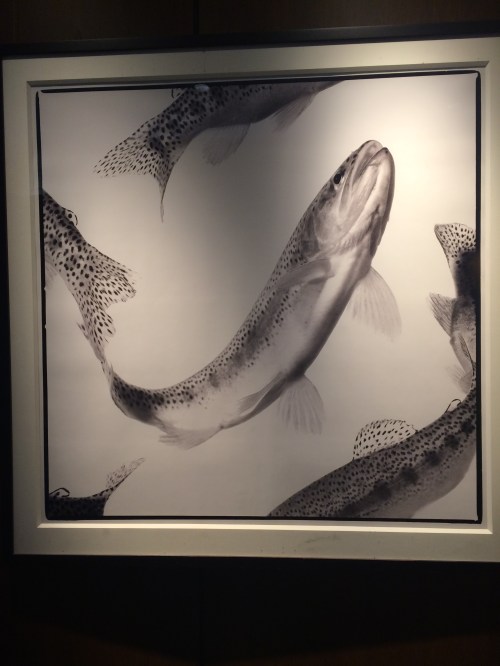
IMG_3685

Photo of Little Kern Golden Trout by Middleton and Liitschwager (1988), hanging in the C Street entrance lobby of the National Academies.


*Acronym decluttering:

SoS: Systems-of-Systems. or a description of complex systems engineering settings where individual components of an overarching system represent complex systems in their own right (such as individual aircraft, with pilots and co-pilots, in the airspace over Washington, DC while Marine One is traveling across town).

PoSE: Perspectives on Systems Engineering.  This is a course that I developed to teach about four distinct traditions of systems engineering, ranging across systems thinking, cybernetics, component-whole relations, and project management.  Only in its second iteration as a hybrid distance / on-campus course, it is one of the most subscribed courses in Engineering Professional Education (and I’m not even teaching it this semester).

ICT: Information and Communications Technology.  When I first started as a faculty member, most computers had line-by-line display screens in single colors of amber or green; email and word processors and bulletin board chat groups were the most sophisticated information exchange tools available.  Even with all of the changes in capability, it’s still important to recognize that the point of these technologies were, and are, for humans to communicate.

SHARK, DOLPHIN, PERCH:  These are designations of project areas within the research lab, referring to knowledge sharing architectures, information flow delays, and applications to healthcare delivery improvement, respectively.  Check them out at https://engineering.purdue.edu/GrouperLab/streams/.

Superposition

With a flourish and frenzy of activity, the cycle has completed itself and begun once more.  This week, of course, was particularly hectic.  On Tuesday, we in GROUPER were pleased to celebrate Liang’s successful defense of her dissertation (now to finish the writing!), and after a 2-hour lab meeting, I went home and got some pleasure reading in.  Wednesday was a travel day, with challenges of unstable weather leading to one canceled flight, and ground stops due to ramp closures at both the start and finish of the second leg of the trip.  Hours late, but with the air cooled from the rain, I finally finished the trip and got home for a good night’s sleep.


“Hold it.  You were at home, then you got stuck during thunderstorms, and finished the trip, and went home?  Did you not get to your destination?  Was your trip canceled?”


Even as I write this entry, there is a type of surrealism about this week.  I’m sitting in one of the chairs I have had for over five years, with Amber on my lap, looking at her cat tree and food and a bunch of other items I clearly recognize.  The window still faces east, but the image is different: instead of an empty parking lot across the street, I see a tall tree and an office building.  In other words, the shift has now occurred.  Amber and I have moved to Washington, DC to start my position as a Jefferson Science Fellow.  My first day is next Monday, and I have begun enjoying the exploration of the neighborhoods of McPherson Square and Thomas Circle, and picking up coffee and pastry and fruit at the White House Street Market.

IMG_3656

Amber exploring the new window view

My world is changing significantly, and yet some things remain consistent.  I am still an engineering faculty member, but I am thinking about a completely different set of issues this August compared to last August.  Our lab meeting addressed a very interesting topic based on students’ recent experiences, and one that I will be considering very hard in the coming months.  Academia, government, and industry are considered vastly different places, and representing wildly divergent career paths for those with PhDs.  And yet, we’re taught (and have first hand experience) that a variety of people all craft their actions, decisions, and processing of information based on perceived risks, costs, and outcome benefits.  There’s only one challenge.  The benefits that drive most industry teams (profit—hey, I hear the new Aston Martins are really nice) don’t come into play at all for most academic or government folks, and the primary risk keeping academic folks up at night (someone already published my idea in that journal I love!) don’t seem to bother industry or government people much.  A government employee may complain bitterly about the costs of having to work 5-10 hours of overtime one week; many academics and industry research folks take a 60-70 hour average work week as pretty much standard.


You may notice that the website (http://www.grouperlab.org) looks very different than a few months ago; that took us a while to work through.  Elliott, our wonder-undergrad, did a pretty thorough redesign and architecture job, but what was more important was not just the scripting language or tab sequences.  We went back to a very basic question: who comes to our lab’s website?  Three different types of groups (yes, it’s that “use case” thing) want distinct types of information, at varying grain sizes.  Even our own GROUPER alums represent different types of interaction profiles.  We’ve got government employees seeing how our work can inform improvements for federal agencies.  GROUPERs are also rising up the ranks in industry, and may be in a position to hire a new or recent grad (in this sense, GROUPER is definitely a distinct and valued brand).  With the lab’s traditional gender mix (somewhere approaching 2/3 female), it’s not surprising that a number of alumnae list their primary function right now as “Mom”.  I see no reason to hide that, or feel guilty or ashamed to highlight such life pathways.  If everything is a system, and GROUPERs look at information everywhere, can’t those skills be applied to everything from medical information use for family members, to understanding the daily experiences of neurodiversity, to getting a front-row seat to the miracles of how humans develop broad processes of learning and skill development sets in ways that still challenge our most sophisticated machine learning algorithms.


Over the next few months, the GROUPER blog will be more active again, but it won’t be focusing as much just on our current lab research.  We’re still researching, of course, but we have other stories to tell, and other forms of impact and effect to consider for how we get, share, and use the information we’ve been gathering and lessons we’ve been learning.  Thanks for visiting us again after our quiet period.  Hey, it gets busy learning how to be in multiple places at once.


Filling in the Blanks

How can it be that it’s been nearly 18 months since my last blog entry?  Well, I could wax philosophic, and point out that the path to such an outcome is like the path to other, more positive outcomes.  It’s an accumulation of daily habits, and a series of perhaps small, but sometimes very distinct, decisions.  So, a bit of a review of what’s been happening, and what lessons can be drawn from both the period of silence and what has filled that silence.


I’m a big fan of waiting for a big, dramatic highlight to emphasize in an announcement.  Back in November, 2014, I was applying for a campus-level directorship position; I was pretty excited about the opportunity, and the ways that I could use my skills to connect research, and STEM engagement, and educational improvements at K-12 and university levels.  I thought I was going to get the position.  I didn’t.  In retrospect, it’s not necessarily that I was a bad candidate for the job, but a bad match for the view (by others) of what the job needed.  This is actually an important distinction, and I am convinced that I had never actually seen the idea of not being selected for a position in that light before.   Well, a few weeks of anticipation were followed by days of anger and frustration, which in turned into a more circumspect view of job searches and candidate interviews no longer just being about showing that someone is “good enough” to be considered.  Imagine that all of the finalists may be “good enough,” in some generic sense, but every complex job is a combination of factors on a very large vector of possible criteria (utility), where different people involved in the selection (stakeholders) have different ideas of the importance (weights) of the criteria, and decide what “best” looks like (stakeholders maximizing their objective function according to their multi-attribute utility weighting).  I was a really good candidate for one version of the job.  I wasn’t the best candidate for another version of the job.  That doesn’t make me a good or bad candidate overall, and certainly not a bad person.  An important lesson to learn, but not one I was ready to write about in Spring 2015.


The lab was going through a significant shift in 2014-15, both conceptually and physically.  We spent the first half of calendar 2015 in Wang Hall, learning how to conduct a different type of meeting with a different configuration of students (three new, first year grad students with only four or five continuing students).  We’re back in Grissom Hall as of August 2015, but the only thing about the building that’s stayed the same on the inside is the walls and bricks and windows framing the building’s outer boundary.  And we’ve had to learn an even more interesting set of dynamics: we are now at a point where much of the lab’s activity officially qualifies as a distributed enterprise.  Dissertation-writing students are working in industry, and other doctoral students are doing co-ops, internships, and other work in multiple time zones.  Lab meetings and 1:1 individual interactions are more likely to occur in Google Hangouts than Grissom 335 (my new office) or the GROUPER dedicated lab space (which doesn’t exist).  So, we have had to learn new lessons about information alignment and distributed knowledge sharing.  That’s a topic for another entry, coming soon.


Believe it or not, the lesson learned about being a good candidate vs. a matching candidate for the job had to be taught to me again in 2015.  This time, the position was a campus administrative post, and again, I thought I was a very good match for a visionary leadership role in a broadly influential and interdisciplinary approach to the future of the campus.  Great, right?  Except that this objective function was apparently not aligned with the utility vector of critical stakeholders.    This is neither good nor bad, in itself.  (Remember what you just told them, Barrett.)  I do believe that the transition from anger to acknowledgement happened faster this time, and to be honest, it’s a lesson that does need a very strong reinforcement over multiple administrations for me to actually learn the meaning well.


Oh, there’s some outcome productivity in terms of field visits, and journal papers, and GROUPER degree completions.  However, I wouldn’t suggest scheduling MS thesis defenses by multiple students on consecutive days.  We succeeded last summer, and now the number of GROUPER MS thesis grads exceeds 30.  But I’m not likely to try that again soon—it’s a lot of reading, and a MS thesis is often as much a test and oral exam for the advisor as for the student.


In the end, I’m better off for it, and I think we in the lab have learned a number of very important and valuable lessons.  It can be dangerous if someone gets too much in the habit of doing without considering, or acting without accepting that both “success” and “failure” can be a benefit or blessing.  One of the challenging, and yet extremely beneficial, outcomes is that the two interviews required me to very explicitly consider the question of how to manage the lab, and in essence, examine what was an appropriate “carrying capacity” of GROUPER at this stage of my career.  (I’m probably more active than ever before, with GROUPER work and GROUPERs in 2015 supported by five federal agencies—AHRQ, FAA, NASA, NSF, VA; it’s not yet the “riding into the sunset” that I had previously considered.)  We’ve been practicing skills that I see in increasing frequency in industry, but not as much in academia—how to become easy and fluent with a team operating across geography, knowledge domain, and a variety of external constraints to be focused and robust to a variety of communication channel capabilities.


More coming soon.  I’m expecting a big announcement in a week or so.  No, really.


Move ’em Out!

In another context, this entry might be seen as “hijacking” the normal GROUPER blog. However, this is a very compatible issue, based on an activity that I have been asked to lead as a member of the Executive Council of the Human Factors and Ergonomics Society (HFES). This activity is an experimental initiative called “Scout the Future”.   So, why do we want to go on a scouting expedition? HFES is a fairly small professional society, with about 5000 members. However, our impact expands throughout the range of home and work environments, including everything from safety improvements in transportation, products, devices, and workplaces, to enhancing our understanding of perception, cognition, biomechanics and decisions in the full range of home, play, and work throughout the lifecycle. That’s a lot. How do we get our voice out, and communicate with the larger world in a proactive way?


Over the past few years, this has been an important and critical concern (“existential” in the sense of our self definition and worry about the future of the HFES itself), especially as we consider the evolution of the discipline to a world of younger professionals who are working in industry contexts of apps and services and products (rather than primarily academics working with government grants and large-scale system developments). How do we adapt ourselves to such an environment? Well, this question came up during a strategic planning exercise just before the 2013 HFES Annual Meeting in San Diego. Frequently, a response to such questions is to set up a task force of very senior people who are charged to figure out the future of the organization and what to do with it. (In fact, that is what HFES has done.) However, there is other research and industry perspectives that suggests that such approaches are not great at identifying or tracking new and disruptive technologies or social trends. Also, examples such as the Lockheed Skunk Works suggest that taking a group of people outside of formal organizational structures may be an effective way of enabling radical innovations. So, I suggested the concept of a scouting expedition…


What if we did something else?


My “something else” is based on an imagined scouting expedition, not unlike the Lewis and Clark Expedition to explore and map the newly-acquired Louisiana Purchase Territory and understand the lands between the Mississippi River and the Pacific Ocean. As an exploration into the unknown, what and who and how much did Lewis and Clark want? Lots of provisions, of course—weapons, sample containers, pencils and paper, items for trade, salt for preserving food… and expertise. The right amount of a diverse set of experts, who could work well together. Not five people: too much material to carry, and too hard for all the expertise required to be available in such a small group. Not five hundred: that’s a bureaucratic organization, with poor lines of communication and unclear distributions of responsibilities. The Corps of Discovery, as the group was described, was about three dozen folks, and they were chosen well. Given the risks and dangers of scouting an unknown expanse with the limited capabilities of the first decade of the 19th Century, the Corps returned intact, with unparalleled growth in understanding of the continent of North America.


Now, when we talk about addressing Global Grand Challenges, or increasing the relevance of human factors in the cyber age, there is a similar expanse of unknown facing us. However, unlike the charge to map the physical wilderness of a continent, this challenge is one of mapping a philosophical territory known as the future. It’s said that humans are bad at making predictions, especially about the future. In fact, I think that’s one of the most significant mistakes we can make, to try to predict specific outcomes. We tend to overestimate technology trends, and underestimate or misread social change. We don’t recognize the impact of “black swans”. We try too hard to guess right in the details, and we get some major factors wrong in the grand picture. No one in the Corps of Discovery woke up one morning and said, “the area on the other side of that river looks like a good place for wheat farming. Let’s tell someone to build a city there… call it Rapid City”. There was no task force to determine the creation of a National Lab, or the potato lobby, or blue football fields, in that place we’ll designate as Idaho. You map the territory, create a good set of observations about how different it might be from expectations, and draw good pictures and tell good stories. (“No, really. We waited all day for the herd of bison to finish going by. You couldn’t see the ground, or hear anything else. You may want to pay attention to that.”)


On that train of graphite and glitter,

Undersea by rail!

Ninety minutes from New York to Paris:

By ’76 we’ll be A-OK….


Just machines that make great decisions,

Programmed by fellows with compassion and vision.

We’ll be clean when that work is done:

Eternally free, yes, and eternally young.

   From “What a Beautiful World / IGY”, by Don Fagen (putting actual predictions from 1957-58 to music)


What happened to those wonderful predictions? No undersea rail: drastically harder than expected. The only aircraft that could do the trip at that speed ceased operations over cost per seat and environmental concerns. No automated decision making. Would we have been better off with it, even if it were possible? People aren’t purely rational, and thus how would a rational machine handle a missile crisis? Revolutions in Africa and Asia? How would such a machine distinguish between Idi Amin and Nelson Mandela, or between a Shah and an Ayatollah?


I don’t want to make those mistakes. But I do want to do something better in terms of exploration and scouting, with those who are better in touch with the future… because they are helping to create it. (Yes, another quote: “The best way to predict the future is to invent it,” by Alan Kay, who gave us the computer mouse.)


Those of you who have spent time with me know that I like to “scan and connect”. The more I find to scan and connect, the better I do. But this isn’t just for me. It’s about creating a network of ideas and elements and people who move the edge of what’s possible in discussing the society. I posted in the first entry of the GROUPER Blog why the lab wouldn’t be tweeting anytime soon. The timing, activity level, and distribution were wrong. But now, there is an HFES Social Networking expert to help us, and a HFES LinkedIn community of discussions. So, let’s try it. I now have a Twitter account: @BSC_HFES_Scout.


BSC Scout

BSC in Scout Mode


Brand Loyalty

After two days at the IIE Annual Conference in Montréal, I was heading to Atlanta early Tuesday morning for the FAA PEGASAS Center of Excellence Annual Meeting. The FAA meeting is for briefing our program managers about our recent progress and technical results; the IIE meeting is about much more. It’s about catching up with old colleagues, prior students, and interesting ideas. I found myself presenting some of Liang’s work in a technical session chaired by one of my academic grandchildren (one of Sandra Garrett’s advisees at Clemson), and becoming an impromptu moderator at Siobhan’s presentation. But, in a dinner discussion with Siobhan and Jake, and two students from Clemson, we also discussed what seems to be another big element of the IIE Meeting: the polo shirts.


I have spoken and written before about GROUPER as brand, as an iconic representation and embodiment of the lab and our topics and style of applied human factors engineering and human-systems integration research / development. We have GROUPER pins, but sometimes I wonder if we need a GROUPER logo shirt. It’s always a good idea to talk to people when you get creative ideas, because I heard some interesting views over dinner. Let’s be clear: IIE Meetings are in part about branding, and presenting and highlighting particular brand is important for many of the attendees. Far from being immune, Purdue IE is one of the prime examples of blatant name recognition and placement. Since 2011, we have sponsored the badge holders for the conference, which means it looks like everyone at IIE is from Purdue. (The badge holders are actually quite nice for those of us who really are from Purdue, as they work well for carrying passports and travel documents. The name-themed, school-color holders are perhaps not quite so enjoyable for those from Ohio State or North Carolina State—whose logo has been emblazoned on hotel key cards longer than we’ve done the badge holders.) We are the home of “Rethink IE,” which is a call to consider the evolution of the profession. But there seems to be something else, and something that is not always seen as good, in pushing one’s brand too far.


Because I had to go directly to the FAA briefing after I get off the plane, I decided to wear my Purdue Industrial Engineering polo shirt this morning.   I also wore it at the Saturday night reception. Yes, I wore black and gold colors, and my GROUPER and Rethink IE pins (both pinned to the badge holder, on the other days of the conference. But a number of students at the IIE meeting do something I have never seen anywhere else in my conference experience. Several times I have found myself walking down the hall to a technical session, only to see a cluster of identically-clad students. For the purposes of this discussion, I’m not going to fixate on particular rivalries or comparisons. It doesn’t matter if we’re talking about the scarlet shirts with the O and buckeye leaves (Ohio State), or the white shirts with the Puerto Rican flag (University of Puerto Rico-Mayaguez), or white shirts with a red stylized boar (Arkansas).   They are proud and pleased to represent their “team” in a coherent and unitary manner. (And, as I have previously written, I get it when you talk about who’s your team.)


Several of the comments over dinner expressed wonder and potential worry over this form of team representation. Would it be seen as a positive sign of camaraderie to have all of the lab appear in identical shirts, or would it be considered a demonstration of excessive conformity? Both Siobhan and Liang are working in the area of healthcare (which we describe as PERCH), but even though they both have the same advisor, they’re not using the same approaches or even addressing the same types of methods. This summer, we’re also making progress on DOLPHIN and CORAL elements of information visualization and sonification (Jake’s presentation at the IIE meeting). What I didn’t expect to hear is that this is something of a recruiting advantage for a subset of people, especially those who have a set of diverse interests and unique perspectives on the changing world of humans, engineering systems, and coordinated / distributed information and expertise in teams. While the lab has grown to a size and capability that active recruiting is not a priority for us, several of our current students started out as interesting conference conversations. GROUPER is not just a recognized brand in our community, but one to which our current students and alumni/ae are very loyal. Ours is not just a university level brand highlighting Purdue, but a unique brand at the level of the individual laboratory. What increases the value of the brand is exciting and transformative research, with excellent and compelling presentations, and not just fancy polo shirts worn in unison. We do have the logos on the slides, and we do wear our GROUPER pins with pride. (However, if you really want a polo shirt anyway, do let me know.)


Who’s Your Team?

(After a recent entry entitled, They Got Game, you might think that this is turning just into a sports blog.  I promise: neither that entry nor this one is only, or even primarily, about sports.)


After a glut of sporting festivity, the college football bowl season and first round of NFL playoffs are now history.  (Because of the winter storm and “polar vortex” that deposited 10 in / 25 cm of snow, followed by temperatures of -22F / -30C, my satellite receiver has been offline since midday Sunday.  Supposedly, there was a fairly entertaining football game on Monday evening.  I hope someone enjoyed it.)  People who know me know that I’m a fairly intense sports fan, and I have followed both college and professional football (and college women’s basketball) for most of my life.  I have also lived in a number of locations and developed attachments to quite a few teams.  (I’m going to assume that at least a few current or alumni GROUPERs were pretty pleased with the outcomes of the Rose and Orange Bowls.)  So, it’s not surprising when I’m asked, Who’s your team?


This was an interesting philosophical question put to me by a close friend while we were watching one or another of the various games.  It became a philosophical question when it was pointed out to me that I was getting more upset at the commentary by the announcers than who was actually winning on the field.  It’s understandable to be disappointed when the team you’re rooting for is losing.  However, my friend pointed out that I was annoyed even when I wasn’t cheering specifically for one of the two teams playing on the field.  Suddenly, I realized that this might not just be about sports.  Fortunately, my friend and I prefer very analytical discussions, so we started to analyze it.  When I have a team that I feel an affiliation to (I consider them a version of “us”), I want them to win.  (If I don’t have an affiliation to the other team, I am perfectly thrilled to have “us” win by a large margin, in what might otherwise be seen as a poor matching of teams.)  But more importantly, I want the game to be exciting and entertaining.  I want the officiating to be consistent, appropriate, and responsive to the rules as they are currently in place.  (Like many fans, I comment about the officiating.  However, I also will frequently observe the penalty and announce both the penalty and penalized player, before the referee does so.  Did I mention I’ve been an intense fan for a long time?)  I don’t like it when the official misses calls.  But I will frequently accept that “we” had a bad play instead of always assuming a “bad ref” when a penalty is called against “us”.  Why is this?  If I want the referees to do their job appropriately (without bias or favoritism), I feel obliged to acknowledge and “own” our errors as well.    I respect good announcers who point out important elements of the game play.  However, I found myself profoundly upset when an announcer would shift from one bias to another just based on the most recent event, using general references that they’ve heard as “it’s generally known” or “everybody thinks that”… (Using trite catchphrases, especially with wrong or mixed metaphors, will always draw specific ire from me.)


This suggests that there is another level of affiliation going on; this other affiliation applies both to the active participation in research at GROUPER and the spectator role for a football game.  It’s not just about sportsmanship, although that’s part of it.  Let’s call it the search for The Better Rule, Well Applied (BRWA).  As you know, academics have their rankings, the equivalent of the Coaches’ Top 25 poll.  The analogy is pretty strong: the rankings for the top US IE graduate programs are voted on by the department heads of those IE programs.  So, I can be excited or upset that Purdue is #10.  But wait.  Let’s look at MIT, ranked #3.  I have an affiliation with MIT, so I should see them as “us,” right?  They don’t have any degree program called Industrial Engineering.  How about Stanford or Cornell?  Great universities.  But there are more people in human factors in Purdue IE than at the corresponding programs (again, not all IE) in those three universities combined.  They don’t do IE human factors.  This issue challenges how we might use the rankings.  I’m actually less concerned about our actual ranking than the distortion.  Hence, this is an issue of BRWA, not just whether we’re better than the (logically nonexistent) competition at a specific other department.


Over the past several years, I’ve had a number of students trying to pick their dissertation topics.  Some of the topics were exotic; others were relatively mundane.  However, I am concerned at how often a topic is considered unworthy because there’s not enough funding in that area.  “Well, you need to compete for, and obtain, competitive grant funding.  You need to show your colleagues at the highly ranked programs how much money you’re bringing in, and place your students at those programs.”  But hold on, my BRWA affiliation screams.  The program at XYZ university doesn’t, and won’t, have an opening in human factors.  My student would rather work in (and is better suited towards) industry or government than a research academic position.  Isn’t graduate training about seeking out creative and innovative solutions that push the frontiers of knowledge and understanding?  Isn’t the PhD supposed to be about supporting the student’s career development, more than mine—in other words, preparing them for what suits them, and appropriately emphasizing their strengths towards their best fitting pathway?


Sometimes, it feels like it is playing a different sport.  Some football folks talk about “winning at all costs”; others talk about integrity and sportsmanship.  They’re supposedly playing the same game, but in reality, they’re not.  In sports, and in research, maybe I’m not just playing for “winning”.  It feels like I’m playing for Truth.  In the lab, what sport are we playing?  Which “Game” do we need to bring?  My sport seems to be University (knowledge, understanding, career preparation), and I want to be a starter—or even captain—on the special GROUPER squad on the BRWA team.  Our team colors include Consent and Connection. …


This may not even be recognizable to other people.  It could sound like I’m rooting for the Montana team in the NFL playoffs.  (Um, not only is there no professional football team in state of Montana, there is no NFL team in any US state that borders on Montana.  Alberta and Saskatchewan have Canadian Football League (CFL) teams.  The CFL championship was played last November.)  How do you recruit for a team in a sport that others might not even see as the right sport to be playing?  Again, this is an interesting philosophical point.  For instance, why is the team BRWA, instead of GROUPER?  GROUPER can’t answer all questions, about all subjects—we specialize in human factors and systems engineering, and you need more than that to do well in University.  These questions aren’t irrelevant to working at Purdue in IE, even if they seem to be ignoring “reality”.  If we don’t ask the question, or consider the options, we never make our team or our sport better.


(By the way, the 2013 CFL Grey Cup Most Valuable Player was Kory Sheets, who was a running back for Purdue.)

They Got Game

You’ve probably seen the highlight film.  If you happened to see the play live, you cheered (if they were on your team), or groaned—even then, you might have to admit it was a memorable play.  The game winning grand slam.  (Yes, I’ve got Red Sox gear, and Phillies gear, at home.)  The clutch goal in the 85th or 90th minute.  (Extra style points for headers or bicycle kicks.)  Or maybe the 90+ yard touchdown run.  (Just to show that I root for Purdue, as well as for Wisconsin.)


I’ve got to witness several of these plays this past Fall, either in the stadium or on live TV.   Even the thought of the play brings a smile to my face. These are peak experiences for athletes, and sometimes even for their fans.  Big plays on big stages, they say.  “Big-time Players make big-time plays.”  But, how do you compare those peak experiences to those of others in other domains?  Do academics have the equivalent of a highlight reel?  Especially those who are in academia, there is a sense of life in the research university as a different tier of performance and competition.  Getting promoted in a US News top-10 ranked program is seen as a major highlight.  Being selected as a Principal Investigator (PI) for a new grant from a major government agency can be a hallmark of one’s career.  Academics even use the metaphors of sports to describe such events.  Home run.  Slam dunk.  Major League.


For a few days this month, that’s how I felt regarding my own research activity right now.  After weeks, or months, or in some cases years of effort, some ideas have been coming to fruition.  At Space Grant, we submitted a proposal to the NSF to provide research experiences for teachers to use the Purdue’s HUB technology infrastructure to develop software models to teach STEM concepts to K-12 students in Evansville, Ft. Wayne, and Indianapolis—and highlight some of these software models in the local science museums there.  I was asked to lead a FAA project to help with improving the quality and safety of weather information provided to pilots during severe weather conditions.   And best of all… A NASA research project that I have dreamed about for months, to help with information flow and task coordination for human-robotic collaboration to do planetary science for lunar and martian moon surfaces—how cool is that?  And my team was selected for such a project, within the Solar System Exploration Research Virtual Institute!  Time to practice my fist pumping, shoulder brushing, touchdown dance?


Not so fast.  It is, of course, November.  This year, “Surviving November” (one of the GROUPER “song titles”) for me has included doctoral prelim exams, grading statistics exams, and evaluating team project summaries in both the statistics course and the capstone design course.  The task lists, and the email inbox, both grow—sometimes faster than I can recognize that I have more tasks to do over the next day, or week.  This is when it’s tough.  Why did I sign up for this?  Why do I put myself under this pressure?  And, in a question that I have asked several of my colleagues… Why am I still trying to get tenure?


The answer to that question is both viciously insidious, and beautifully clear.  I’ve been working like this for the past 30 years.  I have lots of ideas, and am rarely satisfied with the standard way of doing things (or having people tell me there’s only one proper or correct way to do it).  In 1983, it was becoming convinced that it was easier to get two undergraduate degrees rather than one.  In 1993, I had to learn that I couldn’t put every cool idea into a single paper that could get me tenure immediately.  But I did like the idea of studying the effects of time delay on tolerance for group interactions using this new technology called the web browser, or examining how to evaluate different options for that new digital voice mail technology being considered for state government.  In 2003, it was believing that I could do more with Indiana Space Grant, and maybe we should try to write a proposal for an upgrade, less than 12 months after doing a complete overhaul of the program and award structure.  So really, what’s been happening is that I have been rewarded and reinforced for being this way.  Intermittent reinforcement works the best, as the operant conditioning psychologists have long known.  If you want to make sure a behavior sticks around for a very long time, reinforce it.  But only do so a fraction of the time—maybe 15% or so.  On a semi-random basis.  (That sounds like grant proposal writing.)  In baseball or in funded research, what do you call a person who has an overall success rate of 40%?  A member of the Hall of Fame.


It’s a tough world, and it’s a devastating level of competition that can emotionally and physically hurt.  There’s no need to make it harder than it is, or to be erratic and cruel just to show the students how hard it can be.  Can it be sufficient to just say, “We’re not going to tolerate less than excellence today”?  That attitude doesn’t start with the award, and it doesn’t end with the award either.  Every day is a struggle, but not necessarily against a competitor.  Maybe it’s against one’s own doubt or insecurity.  Perhaps it is just the need to push back the veil and curtain of ignorance.  And sometimes, it’s just the desire to do just a little bit better than last time, or see if one can do just as well as last time.


I don’t want to be on the sidelines.  I want to participate.  Even if I’m tired tonight, I want to be able to function tomorrow.  And tomorrow, the game starts anew.